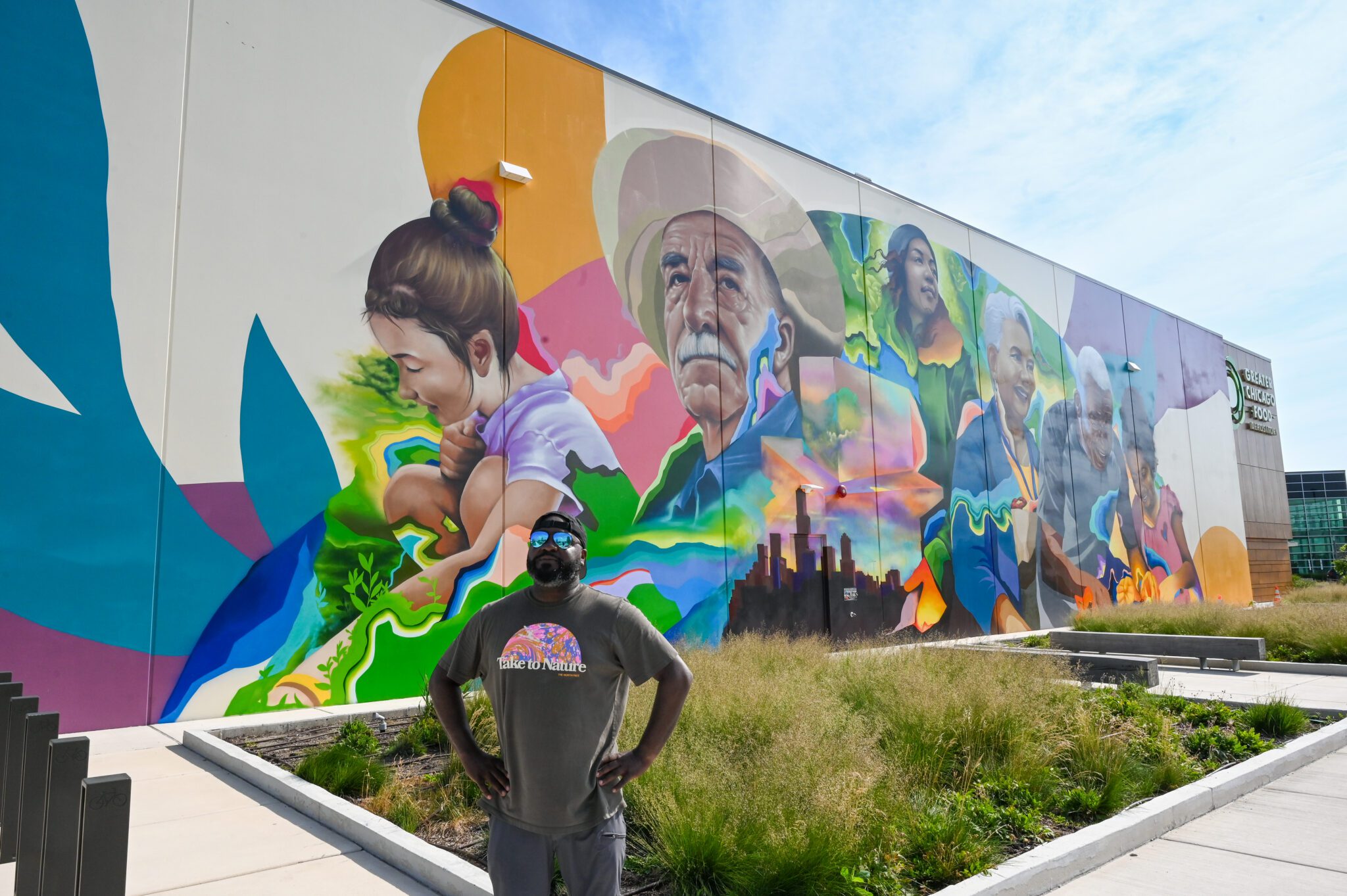
Public art can help a community see its own values reflected back at it. In July 2026, Chicago muralist Max Sansing completed a large new work on the front of the Greater Chicago Food Depository, using color, portraits, and scenes of food and community life to honor the people involved in hunger relief across the city.
Community kitchens as inspiration
The Food Depository asks each artist who works on the building to respond to a simple prompt: Chicago’s community kitchens. Sansing’s interpretation includes people tending a garden, working with produce, volunteering, cooking together, and looking toward the city skyline. It is a visual reminder that hunger relief is not the work of one institution. It depends on neighbors, volunteers, growers, donors, food-service workers, community partners, and the people who come together around a table.
For Sansing, the subject carried personal meaning. Growing up on Chicago’s South Side, he saw the impact that limited access to fresh, affordable food can have on a neighborhood. His mural brings that experience into conversation with the Food Depository’s mission, while centering the people whose care and participation make that mission real.
Making an essential system visible
Food systems can feel abstract until they are seen through the lives of people who depend on and sustain them. The mural gives public form to relationships that often happen behind the scenes: the volunteer lifting produce, the neighbor preparing a meal, the worker moving food through a distribution network, and the community member advocating for greater access.
Its composition also points to connection. Sansing described the arch over the figures as an “under one roof” idea—an image of people who care about each other and the work they do. That is a meaningful frame for hunger relief, where dignity and belonging are as important as the meal itself.
Art as an invitation to participate
The Food Depository plans to renew the exterior mural periodically with work by different local artists. This practice turns the building into a living public canvas and creates an entry point for more people to encounter the anti-hunger movement. A mural cannot solve food insecurity, but it can help people notice the shared responsibility and collective effort that meaningful solutions require.
Sansing’s work offers a bright, human-centered welcome to everyone who passes the building. It celebrates the many hands and stories that make hunger relief possible—and invites Chicagoans to see themselves as part of the work. Read the Food Depository’s full mural story.
Check out more articles
Discover more breakthroughs from our initiatives.